How a New Court is Surfaced: 5 Steps from Start to Completion
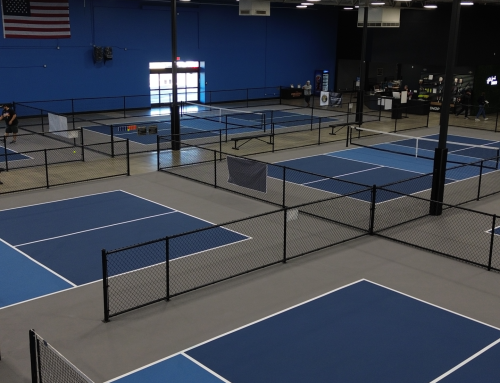
Surfacing a new court is a precise process that combines craftsmanship, high-quality materials, and attention to detail. Whether the goal is to build a tennis, pickleball, or multi-use court, each step plays a critical role in ensuring durability, safety, and long-lasting performance.
1. Prepare the Concrete Slab
We start with a slab that has a light to medium broom finish. If there are saw cuts or joints in the court, they are filled with a special acrylic filler.
2. Sand and Clean the Surface
We move right to sanding the entire court with a large, walk-behind floor sander with a 12-grit sanding pad. After, the court is blown off to ensure it is completely clean. A clean surface is crucial to the adhesion process.
3. Apply Adhesion Promoter and Base Coat
Adhesion promoter is then applied to the entire court surface. The role of adhesion promoter is to ensure that the bare concrete bonds with the acrylic. The base coat of acrylic resurfacer is used to hide any imperfections in the slab, cover any patches, and acts as a base coat for the following color coats.
4. Color Coating and Striping
After applying base, courts are often laid out and boundaries are marked. Color coats come next and there are always two coats of this product. Once all the color coats are applied, the lines are laid out and striped with a two-part system consisting of a primer and the white, textured line paint.
5. Let Cure and Enjoy
The court then needs to cure for 24 hours before the customer is ready to play!
Ready to Resurface or Rebuild Your Court?
By following these five steps, you can see how much care and precision goes into creating a high-quality playing surface. If your court is due for resurfacing (or you’re ready to build a brand-new one), our team is here to help. Contact us today for a free quote and bring your court back to life.